The allure of easy money often leads individuals down perilous paths. We have seen how attempts to introduce counterfeit currency into the financial system, even in small amounts, can backfire spectacularly. This case illustrates the significant risks involved and how sophisticated detection methods can unravel such schemes, even when using materials advertised as "prop money for sale nearby" or "realistic fake money Australia."
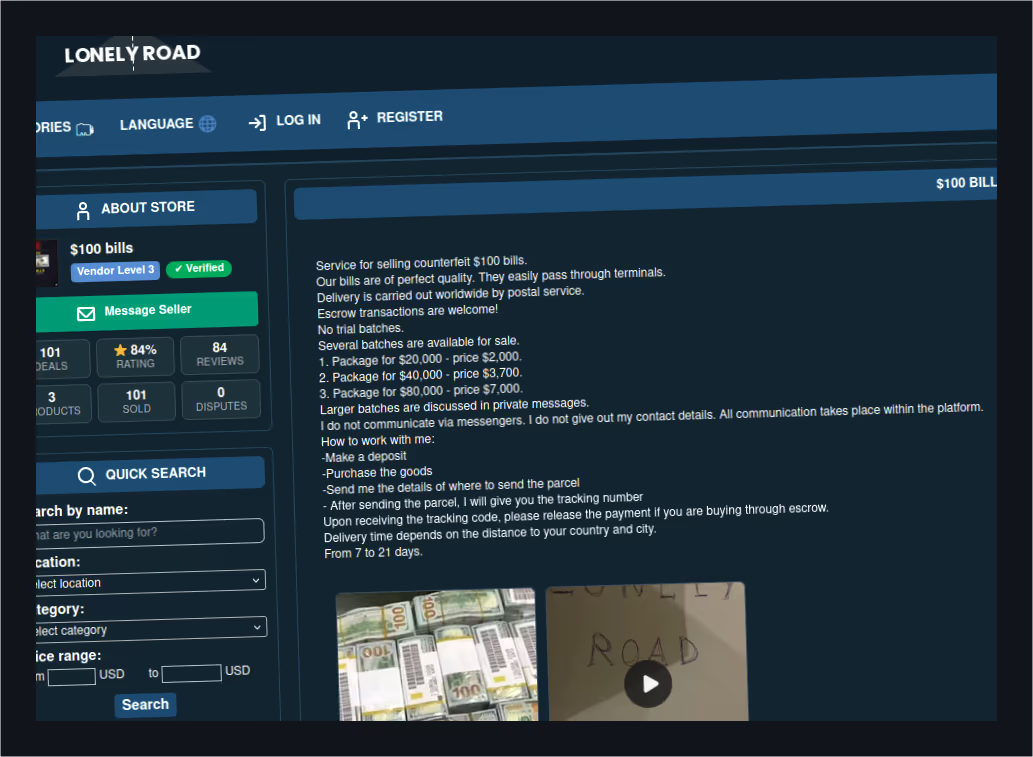
We understand the interest in privacy and anonymity, but it is crucial to recognize that activities like buying "fake 100 dollar note" or "counterfeit $20 dollar bills" on the dark web carry severe penalties. The story we are about to share highlights the consequences of attempting to exploit the banking system with fake money dollar bills. The website where the purchase was made claimed to offer indistinguishable counterfeits, yet the outcome proved otherwise.
- The Setup: Acquiring Counterfeit Currency
In January 2025, a 29-year-old man known as Derek H. from Denver, Colorado, devised what he thought was a clever plot. He allocated $1,200 in cryptocurrency to acquire 40 counterfeit $100 bills from a darknet marketplace. The seller claimed these notes were of "superdollar quality," implying they featured UV protection, magnetic strips, and watermarks similar to authentic currency. Derek aimed to deposit these fraudulent bills at ATMs that accept cash, intending to either withdraw or transfer the money. Initially, he managed to use two ATMs, withdrawing a combined total of $800. However, issues soon arose with later transactions, leading to his arrest just three weeks later.
- The Attempt: Depositing the Fake Money
Derek initiated his scheme by depositing counterfeit $100 bills into ATMs. Initially, his strategy yielded positive results, with his account gaining $800 from the first two machines. However, issues arose when he attempted further deposits. The third ATM rejected a bill because of a malfunction, while the fourth accepted a note but marked the transaction for additional review. This experience underscored the significant pitfalls in Derek's flawed method of handling fake currency.
Before proceeding with such activities, we recommend evaluating the associated risks carefully.
- The Fallout: Account Frozen and Arrest
Derek's actions led to immediate repercussions. The day after the suspicious transaction, his bank took the step of freezing his account, blocking any access to his money. This incident highlights the sophisticated measures implemented by financial institutions and law enforcement to identify and act upon attempts to introduce counterfeit $100 bills into the banking system. Even high-quality counterfeit money bought on the darknet or fake $20 bills face rigorous examination.
- How Banks Detect Counterfeit Currency
How did the bank uncover Derek's scheme, despite the supposed "superdollar quality" of the counterfeit $100 dollar note? Modern ATMs and banking systems employ sophisticated detection technologies beyond simple visual inspection. These include multi-spectral analysis, which examines ink properties, paper composition, and security threads under various light spectra. They also analyze magnetic ink, microprinting, and holographic features. Anomalies in these characteristics, even subtle ones, trigger alerts. Furthermore, patterns of unusual deposits, especially with counterfeit money, are flagged for human review. The combination of returned bills, flagged transactions, and potentially previous suspicious activity led to the bank's quick response and subsequent investigation, proving that even a "fake money site" cannot guarantee immunity from detection.
The Inevitable Consequences of Counterfeiting
This case serves as a stark reminder of the severe repercussions associated with attempting to use counterfeit currency. We strongly advise against engaging in such activities, as the legal and financial consequences are profound. The promise of "superdollar quality" is often a deception, and modern banking systems are equipped to detect even the most convincing fake counterfeit money. Always remember that anonymity on the dark web does not equate to immunity from the law.
Questions readers ask
What are the penalties for using counterfeit money?
The penalties for using counterfeit money in the United States can include significant fines and up to 20 years in prison, depending on the amount and intent.
Can ATMs detect fake money?
Yes, modern ATMs are equipped with advanced sensors that can detect various security features in currency, making them capable of identifying many types of fake counterfeit money.
What is "superdollar quality" counterfeit money?
"Superdollar quality" refers to highly sophisticated counterfeit bills that are designed to mimic genuine currency so closely that they are difficult to distinguish without specialized equipment.
Is buying prop money for sale legal?
While buying prop money for sale is legal for legitimate purposes like film production, using it as real currency is illegal and carries severe consequences.
Sources
Related resources
We collect these links for readers who want to compare options. Where to go.